


Classifications Of Law- Law can be classified into various categories based on its nature, source, purpose, and application. Below are the main classifications of law:
1. Public Law
Public law governs the relationship between individuals and the state. It includes:
- Constitutional Law: Deals with the structure and functioning of the government, fundamental rights, and duties of citizens.
- Administrative Law: Governs the activities of administrative agencies of government.
- Criminal Law: Defines offenses against the state, society, or public order and prescribes punishments.
2. Private (or Civil) Law
Private law regulates relationships between private individuals or entities. It includes:
- Contract Law: Governs agreements and obligations between parties.
- Tort Law: Addresses civil wrongs (e.g., negligence, defamation) and provides remedies.
- Property Law: Regulates ownership, use, and transfer of property.
- Family Law: Covers matters like marriage, divorce, adoption, and child custody.
- Succession Law: Governs the distribution of a deceased person’s estate.
3. Substantive and Procedural Law
- Substantive Law: Defines rights, duties, and obligations of individuals (e.g., criminal offenses, rights to property).
- Procedural Law: Establishes the process for enforcing substantive law (e.g., rules of court procedure, evidence).
4. National and International Law
- National Law (Domestic Law): Governs activities within a specific country, including both public and private laws.
- International Law: Regulates relationships between nations and international entities. It includes:
- Public International Law: Governs treaties, diplomacy, and international organizations.
- Private International Law: Resolves conflicts of laws in cross-border disputes.
5. Common Law and Civil Law
- Common Law: Based on judicial precedents (case law) and is prevalent in countries like the UK, the US, and other former British colonies.
- Civil Law: Based on codified statutes and is the primary legal system in most European and Latin American countries.
6. Other Classifications
Cyber Law: Addresses legal issues related to the internet, technology, and digital communications.
Natural Law: Based on moral principles and universal justice.
Positive Law: Created by legislative bodies and enforceable by the state.
Corporate Law: Governs the formation, operation, and dissolution of companies.
Environmental Law: Focuses on the protection of the environment and natural resources.
What is Required Classifications Of Law
The required classifications of law refer to fundamental categories or groupings essential for understanding and organizing legal systems. These classifications are universally recognized and foundational for legal study and practice. Below are the primary required classifications of law:
1. Public and Private Law
- Public Law: Governs the relationship between individuals and the state.
- Includes Constitutional Law, Administrative Law, and Criminal Law.
- Private Law: Governs relationships between individuals or private entities.
- Includes Contract Law, Tort Law, Property Law, and Family Law.
2. Substantive and Procedural Law
- Substantive Law: Defines legal rights, duties, and liabilities (e.g., laws prohibiting theft or granting property ownership).
- Procedural Law: Lays down the process for enforcing substantive law (e.g., rules of evidence or court procedures).
3. Civil and Criminal Law
- Civil Law: Addresses disputes between individuals or entities and provides remedies (e.g., compensation in contract or tort cases).
- Criminal Law: Deals with offenses against society or the state and prescribes punishments (e.g., imprisonment or fines).
4. National and International Law
- National (or Domestic) Law: Applies within a country’s borders and governs individuals and entities subject to its jurisdiction.
- International Law: Regulates relationships between states, international organizations, and sometimes individuals.
- Public International Law: Treaties, customs, and diplomatic relations.
- Private International Law: Conflict of laws in cross-border private disputes.
5. Common Law and Civil Law
- Common Law: Based on judicial precedents (case law) and is applied in countries like the UK and the US.
- Civil Law: Codified system of laws, prevalent in many European and Asian countries.
6. Natural and Positive Law
- Natural Law: Derived from moral principles and universal ethics; often linked to justice and human rights.
- Positive Law: Law created and enforced by governmental authority, regardless of moral considerations.
7. Mandatory and Persuasive Law
- Mandatory (Binding) Law: Must be followed (e.g., statutes or precedents in a jurisdiction).
- Persuasive Law: Influences decisions but is not binding (e.g., decisions from foreign courts or academic writings).
These classifications are essential for understanding the organization and functioning of any legal system. They provide the framework within which laws are applied and interpreted.
Who is Required Classifications Of Law
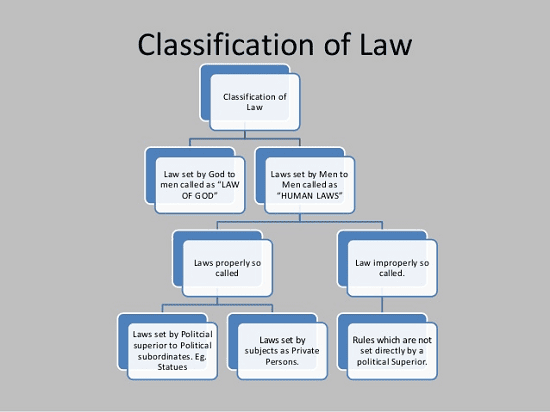
The term “Required Classifications of Law” refers to the categories or branches of law that are essential for understanding and organizing a legal system rather than a specific person. It is not associated with a “who” but rather describes a conceptual framework for classifying laws into distinct groups.
These classifications are determined and established by legal scholars, jurists, and lawmakers to provide a systematic approach to understanding how laws are created, applied, and enforced. The concept itself evolves through centuries of legal thought and practice, influenced by legal systems, traditions, and jurisdictions around the world.
If you’re looking for information about the creators or influencers of legal classifications, notable contributors include historical and modern legal theorists like:
- Aristotle and Cicero: Early philosophers who discussed natural law and justice.
- Thomas Aquinas: Linked law to moral and theological principles.
- John Austin: A key figure in defining positive law.
- H.L.A. Hart: Modernized the understanding of legal systems and classifications in his works on legal positivism.
When is Required Classifications Of Law
The concept of “Required Classifications of Law” is not tied to a specific moment in time but is a fundamental part of legal systems and has been developed, refined, and applied throughout history. It is always relevant, as these classifications are used to organize and apply the law in different contexts.
Here’s how the timeline of the development and application of these classifications evolved:
1. Ancient Times
- Early societies like Mesopotamia (Code of Hammurabi, ~1754 BCE) and Rome (e.g., Roman law) began categorizing laws to govern relationships between people, property, and the state.
- The concepts of public law (state-related) and private law (individual-related) were first recognized in Roman legal traditions.
2. Medieval Period
- Natural law theories, rooted in the philosophy of St. Thomas Aquinas (13th century), provided a moral and theological foundation for law.
- Feudal laws in Europe further divided law into land ownership laws, criminal laws, and governance rules.
3. Modern Era
- The emergence of codified laws like the Napoleonic Code (1804) introduced structured systems that distinguished between civil law (private rights) and criminal law.
- Legal theorists like John Austin (19th century) and H.L.A. Hart (20th century) shaped modern legal classifications such as substantive vs. procedural law and positive vs. natural law.
4. Contemporary Relevance
- The required classifications of law are permanently in use in modern legal systems worldwide, guiding lawmaking, legal education, and judicial interpretation.
- They are applied in courts, legislatures, and academic settings to ensure clarity and consistency in how laws are understood and enforced.
When are These Classifications Relevant?
- Legal Practice: Lawyers and judges rely on these classifications to resolve disputes and interpret laws.
- Legislation: Lawmakers use them to draft new laws within appropriate categories (e.g., environmental law or administrative law).
- Legal Education: Students and scholars study classifications to understand the scope and function of the law.
Where is Required Classifications Of Law

The “Required Classifications of Law” are not confined to a specific location. Instead, they are fundamental frameworks applied universally in legal systems across the world to organize and interpret laws. These classifications are present wherever laws are enacted, practiced, or studied. Here’s how and where they are relevant:
1. In National Legal Systems
Every country uses classifications of law to structure its legal system, though the specifics may vary:
- United States: Laws are classified as federal or state, public or private, civil or criminal, substantive or procedural.
- United Kingdom: The common law system emphasizes classifications such as case law, statutory law, public law, and private law.
- France and Germany: Civil law systems rely on codified statutes and clear divisions, such as criminal, administrative, and civil law.
2. In International Law
- International Institutions: Organizations like the United Nations (UN), World Trade Organization (WTO), and International Court of Justice (ICJ) use classifications like public international law (e.g., treaties) and private international law (e.g., resolving cross-border disputes).
- Regional Agreements: Classifications of law play a key role in treaties like the European Union (EU) legal framework.
3. In Academic Institutions
- Universities and law schools worldwide teach classifications of law to help students understand legal systems. For example:
- Harvard Law School (USA) focuses on distinctions like constitutional law, criminal law, and procedural law.
- Sorbonne University (France) emphasizes codified systems like private law (civil obligations) and public law (administrative law).
4. In Courtrooms
- National Courts: Judges rely on these classifications to determine the appropriate laws and procedures for cases (e.g., applying criminal law in theft cases or family law in divorce cases).
- International Courts: Courts like the International Criminal Court (ICC) classify laws to address war crimes and crimes against humanity.
5. In Legislative Bodies
- Legislators use classifications to draft laws within appropriate domains, such as environmental law, commercial law, or criminal law, based on societal needs.
Where Are They Found in Written Form?
- Legal Codes and Statutes: E.g., the Napoleonic Code, United States Code (USC), or Indian Penal Code (IPC).
- Judicial Precedents: Case law often outlines these classifications in decisions.
- Legal Treatises and Textbooks: Scholars document and refine these classifications in academic works.
How is Required Classifications Of Law
The Required Classifications of Law work as a structured framework to organize, understand, and apply legal principles systematically. These classifications are essential for creating, interpreting, and enforcing laws effectively within any legal system. Here’s how they function and their significance:
1. Organizing Legal Systems
Classifications of law provide a clear structure to divide complex legal principles into manageable categories. This helps:
- Lawmakers draft laws specific to different areas (e.g., criminal law vs. contract law).
- Judges apply the correct legal principles to cases based on their classification.
- Legal professionals specialize in specific areas (e.g., family law or corporate law).
2. Providing Clarity and Predictability
By categorizing laws, these classifications ensure:
- Clarity: Clear boundaries between different types of laws (e.g., civil vs. criminal law).
- Predictability: Citizens and legal practitioners can predict how laws will apply in various situations.
3. Differentiating Rights and Responsibilities
Classifications distinguish between various aspects of law to address specific issues:
- Substantive Law: Defines rights, duties, and obligations (e.g., the right to property, prohibition of theft).
- Procedural Law: Specifies how to enforce those rights or resolve disputes (e.g., court rules, filing procedures).
4. Addressing Relationships
Classifications help in governing specific relationships:
- Public Law: Manages relationships between individuals and the state (e.g., criminal or constitutional law).
- Private Law: Governs interactions between private individuals or entities (e.g., family or property law).
5. Resolving Conflicts
When disputes arise, classifications guide how cases are resolved:
- Civil Law: Provides remedies like compensation in private disputes.
- Criminal Law: Prescribes punishments for offenses against society.
6. Facilitating International Cooperation
Classifications like international law promote global harmony:
- Public International Law: Governs treaties and relations between nations.
- Private International Law: Resolves cross-border disputes involving individuals or corporations.
7. Adapting to Societal Needs
The classifications evolve to address new challenges, such as:
- Environmental Law: To combat climate change and protect natural resources.
- Cyber Law: To regulate digital activities and online privacy.
Practical Example of How It Works
- A theft case is classified under criminal law, where the state prosecutes the offender.
- A breach of contract is classified under civil law, where the aggrieved party seeks compensation.
- A constitutional challenge is resolved under public law, examining whether a law violates the constitution.
By systematically organizing laws into categories, the required classifications of law serve as the foundation for understanding, developing, and enforcing justice in any legal system.
Case Study on Classifications Of Law

A Real Estate Dispute with Criminal Implications
Background
John, a property owner, leases his apartment to Sarah under a contract. According to their agreement, Sarah must pay monthly rent and is prohibited from making significant modifications to the property without John’s consent. Over time, Sarah fails to pay rent for three months and, without permission, demolishes a wall in the apartment to expand a room. When John confronts her, Sarah threatens him with physical harm.
This scenario gives rise to disputes that involve multiple classifications of law.
1. Civil Law: Breach of Contract
- Legal Classification: Civil Law → Private Law → Contract Law.
- Issue: Sarah’s failure to pay rent constitutes a breach of contract.
- Legal Remedy: John can file a civil suit seeking compensation for unpaid rent and damages for the unauthorized modification to his property.
2. Property Law: Unauthorized Modification
- Legal Classification: Civil Law → Private Law → Property Law.
- Issue: Sarah’s demolition of the wall violates John’s property rights.
- Legal Remedy: John can seek an injunction to prevent further damage and demand restoration of the property to its original state.
3. Criminal Law: Threat of Violence
- Legal Classification: Criminal Law → Public Law.
- Issue: Sarah’s threat of physical harm is a criminal offense (e.g., intimidation or assault, depending on jurisdiction).
- Legal Action: John can report this to the police, and the state can initiate a criminal case against Sarah. Punishments could include fines or imprisonment.
4. Procedural Law: Filing the Case
- Legal Classification: Procedural Law → Rules of Civil and Criminal Procedure.
- Issue: John needs to follow proper procedures to file his complaints in both civil and criminal courts.
- For the civil case, he must file a suit in a court with jurisdiction over property disputes.
- For the criminal case, he must file a police complaint, and the case will proceed under the criminal procedure code.
5. Constitutional Law: Right to Fair Trial
- Legal Classification: Public Law → Constitutional Law.
- Issue: Both John and Sarah have a right to a fair trial under the constitution.
- Legal Principle: The courts must ensure that due process is followed, and both parties are given an opportunity to present their cases.
6. Environmental Law: Potential Damage
- Legal Classification: Public Law → Environmental Law.
- Issue: If Sarah’s demolition work caused environmental harm (e.g., improper disposal of debris), she could also face action under environmental regulations.
- Legal Action: Local authorities may impose fines or penalties.
Analysis and Outcome
- Civil Law Outcome: The court orders Sarah to pay the unpaid rent, compensates John for the property damage, and issues an injunction to prevent further modifications.
- Criminal Law Outcome: Sarah is prosecuted for her threats, and the court imposes a fine or prison sentence, depending on the severity.
- Property Law Outcome: Sarah must restore the property to its original state.
- Environmental Law Outcome: If environmental damage occurred, Sarah could be penalized by local authorities.
Conclusion
This case illustrates how different classifications of law—civil, criminal, property, constitutional, procedural, and environmental—intersect in real-life disputes. By applying these classifications, the legal system ensures justice is served for all parties involved.
White paper on Classifications Of Law
Abstract
This white paper examines the concept of legal classifications, their importance, and their role in organizing and applying laws within various legal systems. It explores the foundational categories of law, their historical development, and practical applications in legal practice, academia, and governance. The paper concludes with insights into the evolving nature of legal classifications in addressing modern challenges such as technology and globalization.
1. Introduction
The legal system is a complex structure designed to regulate relationships, enforce rights, and resolve disputes. To function effectively, laws must be categorized systematically. These classifications help organize legal principles, facilitate understanding, and ensure consistent application. This paper provides a comprehensive overview of the essential classifications of law, their definitions, and their significance in legal systems worldwide.
2. Primary Classifications of Law
2.1 Public and Private Law
- Public Law governs the relationship between individuals and the state, ensuring societal order and public interest. It includes:
- Constitutional Law: Addresses the framework of government and fundamental rights.
- Administrative Law: Regulates government agencies and public administration.
- Criminal Law: Defines offenses against the state and prescribes punishments.
- Private Law regulates relationships between private individuals or entities. It includes:
- Contract Law: Governs agreements and obligations.
- Tort Law: Deals with civil wrongs and remedies.
- Family Law: Covers marriage, divorce, and child custody.
2.2 Substantive and Procedural Law
- Substantive Law: Defines rights, duties, and liabilities (e.g., laws prohibiting theft or granting property ownership).
- Procedural Law: Establishes processes for enforcing substantive law, such as court procedures and rules of evidence.
2.3 Civil and Criminal Law
- Civil Law: Resolves disputes between private parties and provides remedies (e.g., compensation for breach of contract).
- Criminal Law: Addresses offenses against society and prescribes punishments (e.g., imprisonment or fines).
2.4 National and International Law
- National Law: Governs activities within a country’s borders and includes both public and private laws.
- International Law: Regulates relationships between nations and international entities. It includes:
- Public International Law: Treaties, diplomacy, and international agreements.
- Private International Law: Resolves conflicts in cross-border disputes between private entities.
2.5 Common Law and Civil Law Systems
- Common Law: Based on judicial precedents (case law) and is practiced in countries like the United States and the United Kingdom.
- Civil Law: Relies on codified statutes and is the dominant legal system in Europe and Latin America.
3. Importance of Legal Classifications
Legal classifications are fundamental for the following reasons:
- Clarity and Organization: They provide a systematic framework for understanding and applying laws.
- Efficient Legal Practice: Specialization within classifications allows lawyers and judges to focus on specific areas, such as criminal or environmental law.
- Legislative Guidance: Lawmakers draft legislation within established categories, ensuring coherence and consistency.
- Dispute Resolution: Classifications help determine the appropriate legal framework for resolving disputes.
- International Cooperation: Common classifications, such as international law, facilitate cross-border agreements and enforcement.
4. Applications in Legal Systems
4.1 Case Study: A Multi-Faceted Dispute
A tenant breaches a rental agreement, damages the property, and threatens the landlord. This case involves:
- Contract Law: To address the breach of the rental agreement.
- Property Law: To resolve unauthorized modifications to the property.
- Criminal Law: To prosecute threats of violence.
4.2 Industrial Applications of Legal Classifications
Legal classifications play a crucial role in various industries by providing clarity and structure for compliance, dispute resolution, and risk management:
- Manufacturing Industry:
- Labor Law: Regulates employer-employee relationships, ensuring compliance with minimum wage laws, workplace safety, and union rights.
- Environmental Law: Enforces standards for waste management, emissions, and sustainable production practices.
- Contract Law: Governs agreements with suppliers, distributors, and customers.
- Technology Industry:
- Intellectual Property Law: Protects innovations, patents, and trademarks.
- Cyber Law: Addresses issues such as data privacy, cybersecurity, and online fraud.
- Contract Law: Covers licensing agreements, software development contracts, and service-level agreements.
- Healthcare Industry:
- Healthcare Law: Regulates patient rights, medical malpractice, and public health standards.
- Administrative Law: Governs the operations of healthcare facilities and compliance with government regulations.
- Contract Law: Deals with agreements between providers, insurers, and patients.
- Financial Industry:
- Banking and Securities Law: Ensures compliance with financial regulations and fraud prevention.
- Tax Law: Governs corporate and individual tax obligations.
- Contract Law: Manages agreements for loans, investments, and mergers.
- Construction Industry:
- Property Law: Addresses land use, zoning regulations, and ownership rights.
- Contract Law: Manages agreements with contractors, subcontractors, and clients.
- Tort Law: Resolves liability issues related to accidents or structural defects.
5. Evolution of Legal Classifications
Legal classifications evolve to address new challenges:
- Technology: Cyber law addresses issues like data privacy, intellectual property, and online fraud.
- Globalization: International trade law and human rights law have gained prominence due to increased global interdependence.
- Environmental Concerns: Environmental law has become critical in addressing climate change, conservation, and sustainable development.
6. Conclusion
Classifications of law are essential for the proper functioning of legal systems. They provide clarity, facilitate enforcement, and adapt to changing societal needs. As the world evolves, so too must these classifications, ensuring that laws remain relevant and effective in addressing emerging issues. By understanding and applying these classifications, legal professionals, scholars, and lawmakers can better serve justice and societal progress.
7. References
- Austin, John. The Province of Jurisprudence Determined. 1832.
- Hart, H.L.A. The Concept of Law. 1961.
- United Nations. Charter of the United Nations. 1945.
- Napoleonic Code. 1804.
Industrial Application of Classifications Of Law
Courtesy: Law Planet
Abstract
This white paper examines the concept of legal classifications, their importance, and their role in organizing and applying laws within various legal systems. It explores the foundational categories of law, their historical development, and practical applications in legal practice, academia, and governance. The paper concludes with insights into the evolving nature of legal classifications in addressing modern challenges such as technology and globalization.
1. Introduction
The legal system is a complex structure designed to regulate relationships, enforce rights, and resolve disputes. To function effectively, laws must be categorized systematically. These classifications help organize legal principles, facilitate understanding, and ensure consistent application. This paper provides a comprehensive overview of the essential classifications of law, their definitions, and their significance in legal systems worldwide.
2. Primary Classifications of Law
2.1 Public and Private Law
- Public Law governs the relationship between individuals and the state, ensuring societal order and public interest. It includes:
- Constitutional Law: Addresses the framework of government and fundamental rights.
- Administrative Law: Regulates government agencies and public administration.
- Criminal Law: Defines offenses against the state and prescribes punishments.
- Private Law regulates relationships between private individuals or entities. It includes:
- Contract Law: Governs agreements and obligations.
- Tort Law: Deals with civil wrongs and remedies.
- Family Law: Covers marriage, divorce, and child custody.
2.2 Substantive and Procedural Law
- Substantive Law: Defines rights, duties, and liabilities (e.g., laws prohibiting theft or granting property ownership).
- Procedural Law: Establishes processes for enforcing substantive law, such as court procedures and rules of evidence.
2.3 Civil and Criminal Law
- Civil Law: Resolves disputes between private parties and provides remedies (e.g., compensation for breach of contract).
- Criminal Law: Addresses offenses against society and prescribes punishments (e.g., imprisonment or fines).
2.4 National and International Law
- National Law: Governs activities within a country’s borders and includes both public and private laws.
- International Law: Regulates relationships between nations and international entities. It includes:
- Public International Law: Treaties, diplomacy, and international agreements.
- Private International Law: Resolves conflicts in cross-border disputes between private entities.
2.5 Common Law and Civil Law Systems
- Common Law: Based on judicial precedents (case law) and is practiced in countries like the United States and the United Kingdom.
- Civil Law: Relies on codified statutes and is the dominant legal system in Europe and Latin America.
3. Importance of Legal Classifications
Legal classifications are fundamental for the following reasons:
- Clarity and Organization: They provide a systematic framework for understanding and applying laws.
- Efficient Legal Practice: Specialization within classifications allows lawyers and judges to focus on specific areas, such as criminal or environmental law.
- Legislative Guidance: Lawmakers draft legislation within established categories, ensuring coherence and consistency.
- Dispute Resolution: Classifications help determine the appropriate legal framework for resolving disputes.
- International Cooperation: Common classifications, such as international law, facilitate cross-border agreements and enforcement.
4. Applications in Legal Systems
4.1 Case Study: A Multi-Faceted Dispute
A tenant breaches a rental agreement, damages the property, and threatens the landlord. This case involves:
- Contract Law: To address the breach of the rental agreement.
- Property Law: To resolve unauthorized modifications to the property.
- Criminal Law: To prosecute threats of violence.
4.2 Industrial Applications of Legal Classifications
Legal classifications play a crucial role in various industries by providing clarity and structure for compliance, dispute resolution, and risk management:
- Manufacturing Industry:
- Labor Law: Regulates employer-employee relationships, ensuring compliance with minimum wage laws, workplace safety, and union rights.
- Environmental Law: Enforces standards for waste management, emissions, and sustainable production practices.
- Contract Law: Governs agreements with suppliers, distributors, and customers.
- Technology Industry:
- Intellectual Property Law: Protects innovations, patents, and trademarks.
- Cyber Law: Addresses issues such as data privacy, cybersecurity, and online fraud.
- Contract Law: Covers licensing agreements, software development contracts, and service-level agreements.
- Healthcare Industry:
- Healthcare Law: Regulates patient rights, medical malpractice, and public health standards.
- Administrative Law: Governs the operations of healthcare facilities and compliance with government regulations.
- Contract Law: Deals with agreements between providers, insurers, and patients.
- Financial Industry:
- Banking and Securities Law: Ensures compliance with financial regulations and fraud prevention.
- Tax Law: Governs corporate and individual tax obligations.
- Contract Law: Manages agreements for loans, investments, and mergers.
- Construction Industry:
- Property Law: Addresses land use, zoning regulations, and ownership rights.
- Contract Law: Manages agreements with contractors, subcontractors, and clients.
- Tort Law: Resolves liability issues related to accidents or structural defects.
5. Evolution of Legal Classifications
Legal classifications evolve to address new challenges:
- Technology: Cyber law addresses issues like data privacy, intellectual property, and online fraud.
- Globalization: International trade law and human rights law have gained prominence due to increased global interdependence.
- Environmental Concerns: Environmental law has become critical in addressing climate change, conservation, and sustainable development.
6. Conclusion
Classifications of law are essential for the proper functioning of legal systems. They provide clarity, facilitate enforcement, and adapt to changing societal needs. As the world evolves, so too must these classifications, ensuring that laws remain relevant and effective in addressing emerging issues. By understanding and applying these classifications, legal professionals, scholars, and lawmakers can better serve justice and societal progress.
7. References
- Austin, John. The Province of Jurisprudence Determined. 1832.
- Hart, H.L.A. The Concept of Law. 1961.
- United Nations. Charter of the United Nations. 1945.
- Napoleonic Code. 1804.
References
- ^ Jump up to:a b c Robertson 2006, p. 90.
- ^ Willis 1926.
- ^ Gibbs, Jack P. (1968). “Definitions of Law and Empirical Questions”. Law & Society Review. 2 (3): 429–446. doi:10.2307/3052897. ISSN 0023-9216. JSTOR 3052897.
- ^ Akers, Ronald L. (1965). “Toward a Comparative Definition of Law”. Journal of Criminal Law and Criminology. 56 (3): 301–306. doi:10.2307/1141239. ISSN 0022-0205. JSTOR 1141239. Archived from the original on 19 July 2018. Retrieved 3 January 2020.
- ^ Spooner, Lysander (1882). Natural Law; or The Science of Justice: A Treatise on Natural Law, Natural Justice, Natural Rights, Natural Liberty, and Natural Society; Showing that All Legislation Whatsoever is an Absurdity, a Usurpation, and a Crime. Part First. A. Williams & Co. Archived from the original on 31 December 2019. Retrieved 31 December 2019.
- ^ Núñez Vaquero, Álvaro (10 June 2013). “Five Models of Legal Science”. Revus. Journal for Constitutional Theory and Philosophy of Law / Revija za ustavno teorijo in filozofijo prava (19): 53–81. doi:10.4000/revus.2449. ISSN 1581-7652. Archived from the original on 31 December 2019. Retrieved 31 December 2019.
- ^ Cohen 1992.
- ^ Rubin, Basha (13 January 2015). “Is Law an Art or a Science?: A Bit of Both”. Forbes. Archived from the original on 3 November 2018.
- ^ Berger 1953, p. 525.
- ^ Mason, Anthony (1996). “The Judge as Law-maker” (PDF). James Cook University Mayo Lecture. Archived (PDF) from the original on 31 December 2019. Retrieved 31 December 2019.
- ^ Devins, Neal (2008). “Congressional Responses to Judicial Decisions”. Encyclopedia of the Supreme Court. Gale MacMillan. pp. 400–403. Archived from the original on 31 December 2019. Retrieved 31 December 2019.
- ^ Berman, Harold J. (1983). “Religious Foundations of Law in the West: An Historical Perspective”. Journal of Law and Religion. 1 (1). Cambridge University Press: 3–43. doi:10.2307/1051071. JSTOR 1051071. S2CID 146933872.
- ^ Fox, Jonathan; Sandler, Shmuel (1 April 2005). “Separation of Religion and State in the Twenty-First Century: Comparing the Middle East and Western Democracies”. Comparative Politics. 37 (3): 317. doi:10.2307/20072892. JSTOR 20072892.
- ^ Cox, Noel (2001). “Ecclesiastical Jurisdiction in the Church of the Province of Aotearoa, New Zealand and Polynesia”. Deakin Law Review. 6 (2): 262. Archived from the original on 31 December 2019. Retrieved 31 December 2019.
- ^ Otto, Jan Michiel, ed. (2010). Sharia incorporated: a comparative overview of the legal systems of twelve Muslim countries in past and present. Leiden University Press. ISBN 9789087280574.
- ^ Raisch, Marylin Johnson. “Religious Legal Systems in Comparative Law: A Guide to Introductory Research – GlobaLex”. Hauser Global Law School Program. New York University School of Law. Archived from the original on 31 December 2019. Retrieved 31 December 2019.
- ^ Horwitz, Morton J. (1 June 1982). “The History of the Public/Private Distinction”. University of Pennsylvania Law Review. 130 (6): 1423–1428. doi:10.2307/3311976. JSTOR 3311976. S2CID 51854776. Retrieved 3 January 2020.[dead link]
- ^ Merryman, John Henry (1968). “The Public Law-Private Law Distinction in European and American Law”. Journal of Public Law. 17: 3. Archived from the original on 12 February 2020. Retrieved 3 January 2020.
- ^ Saiman, Chaim N. (6 July 2008). “Public Law, Private Law, and Legal Science”. American Journal of Comparative Law. 56 (961). Social Science Research Network: 691–702. doi:10.5131/ajcl.2007.0023. Archived from the original on 28 April 2020. Retrieved 3 January 2020.
- ^ Harlow, Carol (1 May 1980). “”Public” and “private” law: definition without distinction”. The Modern Law Review. 43 (3): 241–265. doi:10.1111/j.1468-2230.1980.tb01592.x. ISSN 1468-2230.
- ^ Samuel, Geoffrey (1 September 1983). “Public And Private Law: A Private Lawyer’s Response”. The Modern Law Review. 46 (5): 558–583. doi:10.1111/j.1468-2230.1983.tb02534.x. ISSN 1468-2230.
- ^ Gordley, James (16 November 2006). Reimann, Mathias; Zimmermann, Reinhard (eds.). “Comparative Law and Legal History”. The Oxford Handbook of Comparative Law: 752–774. doi:10.1093/oxfordhb/9780199296064.013.0024. ISBN 9780199296064. Archived from the original on 31 December 2019. Retrieved 31 December 2019.
- ^ Bor, Fredric L. (1974). “The nexus between philosophy and law”. Journal of Legal Education. 26 (4): 539–543. ISSN 0022-2208. JSTOR 42896964.
- ^ Rubin, Paul H. “Law and Economics”. The Library of Economics and Liberty. Liberty Fund, Inc. Archived from the original on 2 July 2019. Retrieved 31 December 2019.
- ^ Banakar, Reza (2003). Merging law and sociology : beyond the dichotomies in socio-legal research. Berlin/Wisconsin: Galda and Wilch Publishing. ISBN 1-931255-13-X.
- ^ Pound, Roscoe (1914). “The End of Law as Developed in Legal Rules and Doctrines”. Harvard Law Review. 27 (3): 195–234. doi:10.2307/1325958. ISSN 0017-811X. JSTOR 1325958.
- ^ Sarat, Austin; Kearns, Thomas, eds. (1996). Justice and Injustice in Law and Legal Theory. University of Michigan Press. pp. 18–19. doi:10.3998/mpub.10283. ISBN 9780472096251. JSTOR 10.3998/mpub.10283.
- ^ “law, n.”. Oxford English Dictionary (Online ed.). Oxford University Press. doi:10.1093/OED/4864419306. (Subscription or participating institution membership required.)
- ^ Rousseau, The Social Contract, Book II: Chapter 6 (Law)
- ^ Dennis Lloyd, Baron Lloyd of Hampstead. Introduction to Jurisprudence. Third Edition. Stevens & Sons. London. 1972. Second Impression. 1975. p. 39.
- ^ Mc Coubrey, Hilaire and White, Nigel D. Textbook on Jurisprudence. Second Edition. Blackstone Press Limited. 1996. ISBN 1-85431-582-X. p. 2.
- ^ Williams, Glanville. International Law and the Controversy Concerning the Meaning of the Word “Law”. Revised version published in Laslett (Editor), Philosophy, Politics and Society (1956) p. 134 et seq. The original was published in (1945) 22 BYBIL 146.
- ^ Arnold 1935, p. 36.
- ^ Baron Lloyd of Hampstead. Introduction to Jurisprudence. Third Edition. Stevens & Sons. London. 1972. Second Impression. 1975.
- ^ Campbell 1993, p. 184.
- ^ Jump up to:a b Bix 2022.
- ^ Jump up to:a b Dworkin 1986, p. 410.
- ^ Jump up to:a b Raz 1979, pp. 3–36.
- ^ Holmes, Oliver Wendell. “The Path of Law” (1897) 10 Harvard Law Review 457 at 461.
- ^ Aquinas, St Thomas. Summa Theologica. 1a2ae, 90.4. Translated by J G Dawson. Ed d’Entreves. (Basil Blackwell). Latin: “nihil est aliud qau edam rationis ordinatio ad bonum commune, ab eo qi curam communitatis habet, promulgata”.
- ^ McCoubrey, Hilaire and White, Nigel D. Textbook on Jurisprudence. Second Edition. Blackstone Press Limited. 1996. ISBN 1-85431-582-X. p. 73.
- ^ Taylor, T. W. (January 1896). “The Conception of Morality in Jurisprudence”. The Philosophical Review. 5 (1): 36–50. doi:10.2307/2176104. JSTOR 2176104.
- ^ Fritz Berolzheimer, The World’s Legal Philosophies, 115–116
- ^ Kant, Immanuel, Groundwork of the Metaphysics of Morals, 42 (par. 434)
- ^ Green, Leslie. “Legal Positivism”. Stanford Encyclopedia of Philosophy. Archived from the original on 9 June 2007. Retrieved 10 December 2006.
- ^ Nietzsche, Zur Genealogie der Moral, Second Essay, 11
- ^ Kazantzakis, Friedrich Nietzsche and the Philosophy of Law, 97–98
- ^ Linarelli, Nietzsche in Law’s Cathedral, 23–26
- ^ Marmor, Andrei (1934). “The Pure Theory of Law”. Stanford Encyclopedia of Philosophy. Archived from the original on 9 June 2007. Retrieved 9 February 2007.
- ^ Bielefeldt, Carl Schmitt’s Critique of Liberalism, 25–26
- ^ Finn 1991, pp. 170–171.
- ^ Bayles 1992, p. 21.
- ^ Raz 1979, p. 37.
- ^ Théodoridés. “law”. Encyclopedia of the Archaeology of Ancient Egypt.
- ^ VerSteeg, Law in ancient Egypt
- ^ Lippert, Sandra (11 February 2016). “Egyptian Law, Saite to Roman Periods”. Oxford Handbooks Online. Oxford University Press. doi:10.1093/oxfordhb/9780199935390.013.48. ISBN 978-0-19-993539-0. Archived from the original on 3 January 2020. Retrieved 3 January 2020.
- ^ Richardson 2004, p. 11.
- ^ Kelly 1992, pp. 5–6.
- ^ Mallory 1997, p. 346.
- ^ Ober 1996, p. 121.
- ^ Kelly 1992, p. 39.
- ^ Stein 1999, p. 1.
- ^ Clarke, M. A.; Hooley, R. J. A.; Munday, R. J. C.; Sealy, L. S.; Tettenborn, A. M.; Turner, P. G. (2017). Commercial Law. Oxford University Press. p. 14. ISBN 9780199692088. Archived from the original on 15 April 2021. Retrieved 10 December 2020.
- ^ Jump up to:a b Mattei 1997, p. 71.
- ^ McAuliffe, Karen (21 February 2013). “Precedent at the Court of Justice of the European Union: The Linguistic Aspect”. In Michael Freeman; Fiona Smith (eds.). Law and Language: Current Legal Issues, Volume 15. Oxford University Press. ISBN 9780199673667. Archived from the original on 1 January 2020. Retrieved 1 January 2020.
- ^ For discussion of the composition and dating of these sources, see Olivelle, Manu’s Code of Law, 18–25.
- ^ Glenn 2000, p. 276.
- ^ Chapra, Muhammad Umer (2014). Morality and Justice in Islamic Economics and Finance. Edward Elgar Publishing. pp. 62–63. ISBN 9781783475728.
- ^ Jackson, Roy (2010). Mawlana Mawdudi and Political Islam: Authority and the Islamic State. Routledge. ISBN 9781136950360.
- ^ Glenn 2000, p. 273.
- ^ Glenn 2000, p. 287.
- ^ Glenn 2000, p. 304.
- ^ Glenn 2000, p. 305.
- ^ Glenn 2000, p. 307.
- ^ Glenn 2000, p. 309.
- ^ Farah 2006, pp. 263–304.
- ^ Pejovic, Caslav (2001). “Civil Law and Common Law: Two Different Paths Leading to the Same Goal”. Victoria University of Wellington Law Review. 32 (3): 817. doi:10.26686/vuwlr.v32i3.5873. Archived from the original on 8 September 2019. Retrieved 31 December 2019.
- ^ “Introduction to Civil Law Legal Systems” (PDF). Federal Judicial Center. INPROL. May 2009. Archived (PDF) from the original on 18 June 2020. Retrieved 1 January 2020.
- ^ “Alphabetical Index of the 192 United Nations Member States and Corresponding Legal Systems”. JuriGlobe. University of Ottawa. Archived from the original on 22 July 2016. Retrieved 1 January 2020.
- ^ “The Economist explains: What is the difference between common and civil law?”. The Economist. 17 July 2013. Archived from the original on 22 December 2019. Retrieved 1 January 2020.
- ^ Gordley & von Mehren 2006, p. 18.
- ^ Gordley & von Mehren 2006, p. 21.
- ^ Stein 1999, p. 32.
- ^ Stein 1999, p. 35.
- ^ Stein 1999, p. 43.
- ^ Hatzis 2002, pp. 253–263.
- ^ Demirgüç-Kunt & Levine 2001, p. 204.
- ^ Carl Schmitt, The Concept of the Political, ch. 7; Crisis of Parliamentary Democracy
- ^ “The World Factbook – Field Listing – Legal system”. CIA. Archived from the original on 26 December 2018. Retrieved 13 October 2007.
- ^ “Magna Carta”. Fordham University. Archived from the original on 10 September 2014. Retrieved 10 November 2006.
- ^ Gordley & von Mehren 2006, p. 4.
- ^ Gordley & von Mehren 2006, p. 3.
- ^ Pollock (ed) Table Talk of John Selden (1927) 43; “Equity is a roguish thing. For law we have a measure… equity is according to the conscience of him that is Chancellor, and as that is longer or narrower, so is equity. ‘Tis all one as if they should make the standard for the measure a Chancellor’s foot.”
- ^ Gee v Pritchard (1818) 2 Swans. 402, 414
- ^ Blackstone, Commentaries on the Laws of England, Book the First – Chapter the First Archived 5 July 2011 at the Wayback Machine
- ^ Gordley & von Mehren 2006, p. 17.
- ^ Ferrari, Silvio (2012). “Chapter 4: Canon Law as a Religious Legal System”. In Huxley, Andrew (ed.). Religion, Law and Tradition: Comparative Studies in Religious Law. Routledge. p. 51. ISBN 978-1-136-13250-6.
Divine law… is eternal and cannot be changed by any human authority.
- ^ Glenn 2000, p. 159.
- ^ Boudinhon, Auguste (1910). “Canon Law”. The Catholic Encyclopedia. Vol. 9. New York: Robert Appleton Company. Archived from the original on 31 March 2019. Retrieved 9 August 2013.
- ^ Wiesner-Hanks, Merry (2011). Gender in History: Global Perspectives. Wiley Blackwell. p. 37.
- ^ Raymond Wacks, Law: A Very Short Introduction, 2nd Ed. (Oxford University Press, 2015) pg. 13.
- ^ Peters, Edward. “Home Page”. CanonLaw.info. Archived from the original on 28 September 2011. Retrieved 24 September 2019.
- ^ Blessed John Paul II, Ap. Const. (1990). “Apostolic Constitution Sacri Canones John Paul II 1990”. Archived from the original on 24 March 2016. Retrieved 26 April 2019.
- ^ Friedman, Lawrence M., American Law: An Introduction (New York: W.W. Norton & Company, 1984), pg. 70.
- ^ William Wirt Howe, Studies in the Civil Law, and its Relation to the Law of England and America (Boston: Little, Brown, and Company, 1896), pg. 51.
- ^ A. Brundag, James (2010). he Medieval Origins of the Legal Profession: Canonists, Civilians, and Courts. University of Chicago Press. p. 116. ISBN 978-0226077598.
- ^ Anderson 1956, p. 43.
- ^ Giannoulatos 1975, pp. 274–275.
- ^ Sherif 2005, pp. 157–158.
- ^ “Saudi Arabia”. JURIST. Archived from the original on 30 August 2006. Retrieved 2 September 2006.
- ^ Akhlaghi 2005, p. 127.
- ^ Hallaq 2005, p. 1.
- ^ Jump up to:a b Markovits 2007.
- ^ Quigley, J. (1989). “Socialist Law and the Civil Law Tradition”. The American Journal of Comparative Law. 37 (4): 781–808. doi:10.2307/840224. JSTOR 840224.
- ^ Smith, G. B. (1988). “Socialist Legality and the Soviet Legal System”. Soviet Politics. Palgrave. pp. 137–162. doi:10.1007/978-1-349-19172-7_7. ISBN 978-0-333-45919-5.
- ^ Edward H. Levi, An Introduction to Legal Reasoning (2013), p. 1-2.
- ^ Jerman v. Carlisle, 130 S.Ct. 1605, 1614, 559 U.S. 573, 587 (2010), Sotomayor, J.
- ^ Heise, Michael (1999). “The Importance of Being Empirical”. Pepperdine Law Review. 26 (4): 807–834. Archived from the original on 25 February 2021. Retrieved 18 December 2019.
- ^ Posner, Eric (24 July 2015). “The rise of statistics in law”. ERIC POSNER. Archived from the original on 20 December 2019. Retrieved 16 August 2019.
- ^ Montesquieu, The Spirit of Laws, Book XI: Of the Laws Which Establish Political Liberty, with Regard to the Constitution, Chapters 6–7 Archived 3 February 2007 at the Wayback Machine
- ^ Thomas Hobbes, Leviathan, XVII
- ^ Caldwell, Ernest (2016). “Chinese Constitutionalism: Five-Power Constitution”. Max Planck Encyclopedia of Comparative Constitutional Law. Archived from the original on 25 February 2022. Retrieved 8 January 2020.
- ^ “A Brief Overview of the Supreme Court” (PDF). Supreme Court of the United States. Archived from the original (PDF) on 6 July 2017. Retrieved 10 November 2006.
- ^ “The Supreme Court of the United Kingdom”. The Supreme Court. Archived from the original on 24 July 2019. Retrieved 12 November 2023.
- ^ “Entscheidungen des Bundesverfassungsgerichts (Decisions of the Federal Constitutional Court)” (in German). Bundesverfassungsgericht. Archived from the original on 21 November 2006. Retrieved 10 November 2006.
- ^ “Jurisprudence, publications, documentation” (in French). Cour de cassation. Archived from the original on 9 February 2007. Retrieved 11 February 2007.
- ^ Goldhaber 2007, pp. 1–2.
- ^ Patterson 2001.
- ^ Dicey 2005, pp. 37–82.
- ^ Jump up to:a b Sherif 2005, p. 158.
- ^ Rasekh 2005, pp. 115–116.
- ^ Jump up to:a b Riker 1992, p. 101.
- ^ Jump up to:a b Haggard & Shugart 2001, p. 71.
- ^ Olson, The New Parliaments of Central and Eastern Europe, 7
- ^ See, e.g. Tuberville v Savage (1669), 1 Mod. Rep. 3, 86 Eng. Rep. 684, where a knight said in a threatening tone to a layperson, “If it were not assize time, I would not take such language from you.”
- ^ “History of Police Forces”. History.com Encyclopedia. Archived from the original on 29 December 2006. Retrieved 10 December 2006.
- ^ [“Des Sergents de Ville et Gardiens de la Paix à la Police de Proximité : la Préfecture de Police au Service des Citoyens” (in French). La Préfecture de Police de Paris. Archived from the original on 6 May 2008. Retrieved 24 January 2007.
- ^ Weber, Politics as a Vocation
- ^ Weber, The Theory of Social and Economic Organisation, 154
- ^ “bureaucracy”. Online Etymology Dictionary. Archived from the original on 15 January 2009. Retrieved 2 September 2007.
- ^ Albrow 1970, p. 16.
- ^ Mises, Bureaucracy, II, Bureaucratic Management Archived 14 September 2014 at the Wayback Machine
- ^ Jump up to:a b Kettl 2006, p. 367.
- ^ Weber, Economy and Society, I, 393
- ^ Kettl 2006, p. 371.
- ^ Hazard & Dondi 2004, p. 1.
- ^ The Sunday Times v The United Kingdom [1979] ECHR 1 at 49 Archived 16 September 2006 at the Wayback Machine Case no. 6538/74
- ^ “British English: Esquire”. Collins Dictionary. n.d. Archived from the original on 6 October 2014. Retrieved 23 September 2014.
- ^ “American English: Esquire”. Collins Dictionary. n.d. Archived from the original on 6 October 2014. Retrieved 23 September 2014.
- ^ Ahmad 2009.
- ^ Hazard & Dondi 2004, pp. 22–23.
- ^ Jump up to:a b Fine, The Globalisation of Legal Education, 364
- ^ Warren, Civil Society, 3–4
- ^ Locke, Second Treatise, Chap. VII, Of Political or Civil_Society. Chapter 7, section 87
- ^ Hegel, Elements of the Philosophy of Right, 3, II, 182 Archived 1 April 2007 at the Wayback Machine
- ^ Karkatsoulis 2004, pp. 277–278.
- ^ (Pelczynski, The State and Civil Society, 1–13; Warren, Civil Society, 5–9)
- ^ Zaleski, Pawel (2008). “Tocqueville on Civilian Society. A Romantic Vision of the Dichotomic Structure of Social Reality”. Archiv für Begriffsgeschichte. 50.
- ^ Robertson, Crimes Against Humanity, 98–99
- ^ Jakobs 2004, pp. 5–6.
- ^ Kaldor–Anheier–Glasius, Global Civil Society, passim Archived 17 August 2007 at the Wayback Machine
- ^ Karkatsoulis 2004, pp. 282–283.
- ^ “History of the UN”. About the United Nations/History. Archived from the original on 18 February 2010. Retrieved 1 September 2008.
- ^ D’Amato, Anthony (11 November 2010). “Is International Law Really ‘Law’?”. Northwestern University Law Review. 79. Archived from the original on 3 August 2020. Retrieved 3 January 2020.
- ^ Schermers-Blokker, International Institutional Law, 900–901
- ^ Petersmann, The GATT/WTO Dispute Settlement System International Criminal Court Archived 23 July 2011 at the Wayback Machine, 32
- ^ Redfem, International Commercial Arbitration, 68–69
- ^ Gaffey, Conor (4 May 2016). “Why the African Union wants to be more like the EU”. Newsweek. Archived from the original on 1 January 2020. Retrieved 1 January 2020.
- ^ Babarinde, Olufemi (April 2007). “The EU as a Model for the African Union: the Limits of Imitation” (PDF). Jean Monnet/Robert Schuman Paper Series. 7 (2). Miami – Florida European Union Center. Archived (PDF) from the original on 1 November 2019. Retrieved 1 January 2020.
- ^ Schermers–Blokker, International Institutional Law, 943
- ^ “C-26/62 Van Gend en Loos v Nederlandse Administratie der Belastingen“. Eur-Lex. Archived from the original on 21 March 2007. Retrieved 19 January 2007.
- ^ “C-6/64 Flaminio Costa v ENEL“. Eur-Lex. Archived from the original on 9 January 2009. Retrieved 1 September 2007.
- ^ Chalmers, D.; Barroso, L. (7 April 2014). “What Van Gend en Loos stands for”. International Journal of Constitutional Law. 12 (1): 105–134. doi:10.1093/icon/mou003. Archived from the original on 26 February 2020. Retrieved 1 January 2020.
- ^ Locke, The Second Treatise, Chapter 9, section 124
- ^ Tamanaha, On the Rule of Law, 47
- ^ Auby 2002, p. 75.
- ^ Cesare Beccaria‘s seminal treatise of 1763–1764 is titled On Crimes and Punishments (Dei delitti e delle pene).
- ^ Jump up to:a b Brody, Acker & Logan 2001, p. 2.
- ^ Jump up to:a b Wilson 2003, p. 2.
- ^ Dennis J. Baker, Glanville Williams Textbook of Criminal Law (London: 2012), 2
- ^ See e.g. Brody, Acker & Logan 2001, p. 205 about Robinson v. California, 370 U.S. 660 (1962).
- ^ See e.g. Feinman, Law 111, 260–261 about Powell v. Texas, 392 U.S. 514 (1968).
- ^ Dörmann, Doswald-Beck & Kolb 2003, p. 491.
- ^ Kaiser 2005, p. 333.
- ^ About R v Dudley and Stephens [1884] 14 QBD 273 DC Archived 28 February 2005 at the Wayback Machine, see Simpson, Cannibalism and the Common Law, 212–217, 229–237
- ^ Pelser, Criminal Legislation, 198
- ^ “The States Parties to the Rome Statute”. International Criminal Court. Archived from the original on 23 June 2011. Retrieved 10 February 2007.
- ^ Wehberg, Pacta Sunt Servanda, 775
- ^ Austotel v Franklins (1989) 16 NSWLR 582
- ^ Jump up to:a b Pargendler 2018.
- ^ e.g. in Germany, § 311 Abs. II Archived 11 January 2007 at the Wayback Machine BGB
- ^ “§ 105 BGB Nichtigkeit der Willenserklärung”. dejure.org. Archived from the original on 9 December 2006. Retrieved 5 December 2006.
- ^ Smith, The Structure of Unjust Enrichment Law, 1037
- ^ Lee, R. W. (April 1918). “Torts and Delicts”. Yale Law Journal. 27 (6): 721–730. doi:10.2307/786478. ISSN 0044-0094. JSTOR 786478. Archived from the original on 1 January 2020. Retrieved 1 January 2020.
- ^ Bolton v Stone [1951] AC 850
- ^ Donoghue v Stevenson [1932] AC 532, 580
- ^ Sturges v Bridgman (1879) 11 Ch D 852
- ^ e.g. concerning a British politician and the Iraq War, George Galloway v Telegraph Group Ltd [2004] EWHC 2786
- ^ Taff Vale Railway Co v Amalgamated Society of Railway Servants [1901] AC 426
- ^ Harris 1994, pp. 610–627.
- ^ e.g. Hunter v Canary Wharf Ltd [1997] 2 All ER 426 Archived 22 September 2017 at the Wayback Machine
- ^ Armory v Delamirie (1722) 93 ER 664, 1 Strange 505
- ^ Matthews 1995, pp. 251–274.
- ^ Savigny 1803, p. 25.
- ^ Locke 1689, Section 123.
- ^ Bristol and West Building Society v Mothew (1998).
- ^ Nestlé v National Westminster Bank plc [1993] 1 WLR 1260
- ^ “A Guide to the Treaty of Lisbon” (PDF). The Law Society. January 2008. Archived from the original (PDF) on 10 September 2008. Retrieved 1 September 2008.
- ^ Berle 1932.
- ^ WIPO, Intellectual Property, 3
- ^ Coase 1937, pp. 386–405.
- ^ Coase 1960, pp. 1–44.
- ^ Jakoby 2005, p. 53.
- ^ Jump up to:a b Cotterrell 1992.
- ^ Jump up to:a b Jary & Jary 1995, p. 636.
- ^ Ehrlich, Fundamental Principles, Hertogh, Living Law, Rottleuthner, La Sociologie du Droit en Allemagne, 109, Rottleuthner, Rechtstheoritische Probleme der Sociologie des Rechts, 521
- ^ Cotterrell 2006.
- ^ Rheinstein 1954, p. 336.
- ^ Cotterrell 1999.
- ^ Johnson 1995, p. 156.
- ^ Gurvitch & Hunt 2001, p. 142.
- ^ Papachristou 1999, pp. 81–82.