

Spirits – Alcohol Definition and Basic Concepts
Spirits, also known as distilled alcohol, are defined as beverages produced through distillation of fermented liquids, resulting in higher alcohol concentrations (typically 20–50% ABV or more) compared to beer or wine. They include categories such as whiskey, vodka, rum, gin, tequila, and brandy, each distinguished by raw materials, distillation methods, and aging processes.
Definition of Spirits
Spirits are alcoholic beverages created by distillation, a process that separates alcohol from water and other components in a fermented liquid. Unlike beer (4–6% ABV) or wine (10–15% ABV), achieve much higher alcohol concentrations, often around 40% ABV. Distillation exploits the lower boiling point of alcohol (78.5°C) compared to water (100°C), allowing vaporized ethanol to be collected and condensed into a stronger liquid.
Origins of the Term “Spirits”
The word “spirits” traces back to medieval alchemy. Early distillers saw the vapor rising during distillation as the “essence” or “spirit” of the liquid. The Latin means breath or vapor, and this concept evolved into the modern term for distilled alcohol. In the Middle Ages, the product was often called aqua vitae (“water of life”), reflecting its perceived vitality.
Basic Concepts
1. Alcohol Content and Proof
- generally range between 20% and 95% ABV, depending on type and production method.
- In the United States, proof is double the ABV (e.g., 40% ABV = 80 proof).
2. Distillation Methods
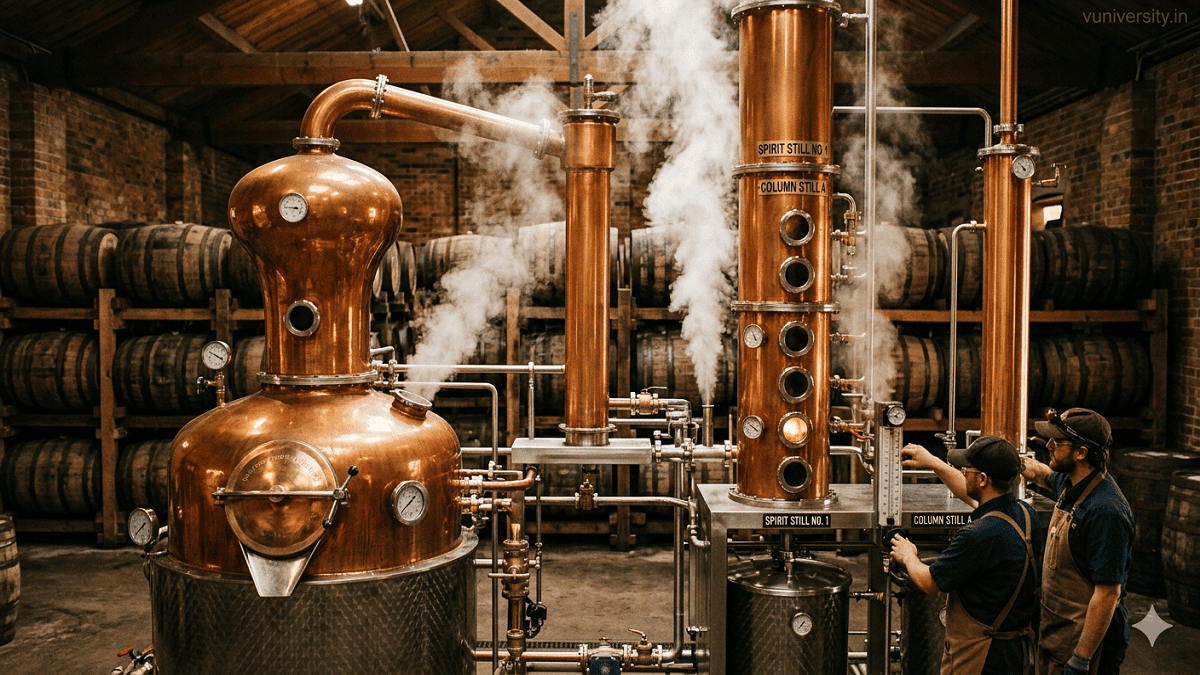
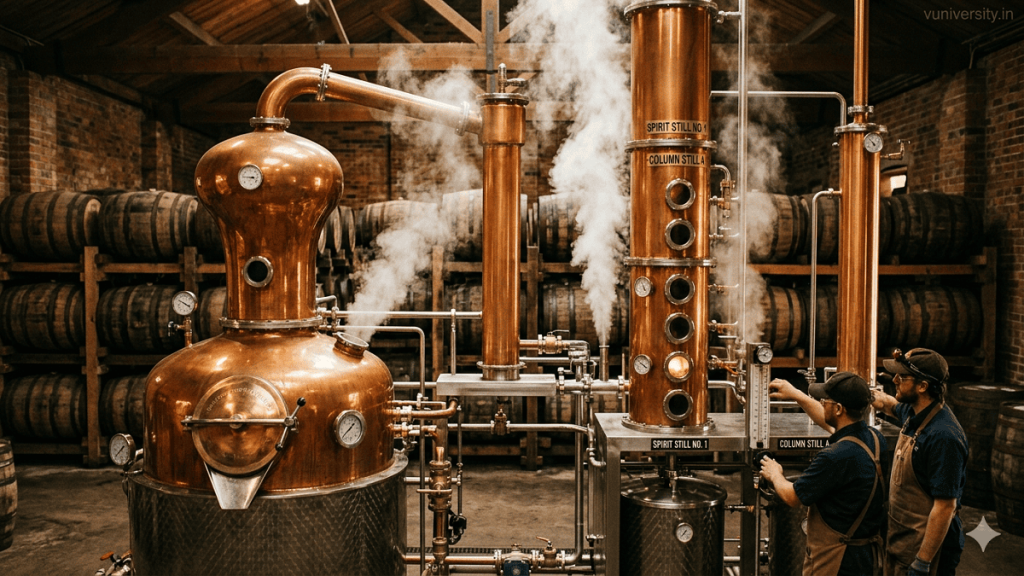
- Pot stills: Batch distillation, retaining more flavor compounds (used for whiskey, brandy, rum).
3. Major Types of Spirits
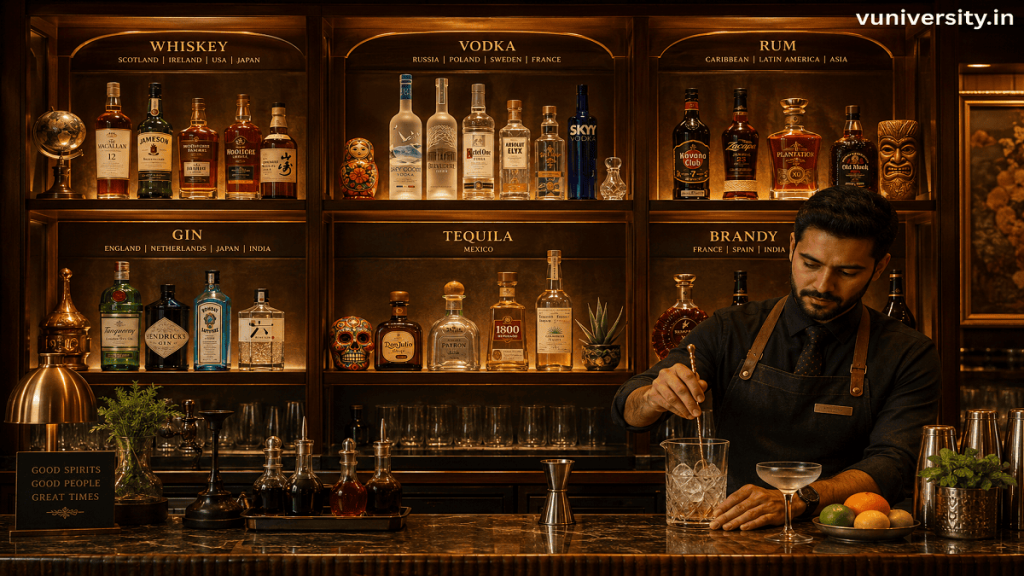
- Vodka: Neutral , distilled from grains or potatoes.
- Whiskey: Grain-based, aged in barrels, includes Scotch, Bourbon, Rye.
- Rum: Distilled from sugarcane or molasses, light or dark depending on aging.
- Gin: Flavored with juniper and botanicals.
- Tequila: Made from blue agave, primarily in Mexico.
- Brandy: Distilled from wine or fruit juice, includes Cognac and Armagnac.
Cultural and Regulatory Context
Spirits play a central role in global drinking traditions, consumed neat, on the rocks, or as cocktail bases. Many are subject to strict regulations, such as minimum aging requirements (e.g., Scotch whisky must age at least three years). Their production also has environmental impacts, including water usage and waste, though sustainable practices are increasingly adopted.
Further Reading
For deeper insights into and alcohol regulation, see:
- World Health Organization – Alcohol (who.int in Bing)
- Distilled Spirits Council of the United States
#BeverageIndustry
What are spirits, and how are they different from other alcoholic beverages?
Spirits are a category of alcoholic beverages produced by distillation, which separates alcohol from water and other components in a fermented liquid. This process yields a much higher alcohol concentration compared to beer or wine. Most spirits fall around 35–50% alcohol by volume (ABV), though some can be stronger depending on production methods.
How Spirits Differ from Other Alcoholic Beverages
1. Production Method
- Beer and wine are made through fermentation alone, where yeast converts sugars into alcohol.
- Spirits undergo fermentation first, but then are distilled. Distillation uses heat to vaporize alcohol (which boils at a lower temperature than water) and condenses it back into liquid form, concentrating the alcohol content.
2. Alcohol Content
- Beer: typically 4–6% ABV.
- Wine: generally 10–15% ABV.
- Spirits: usually 35–50% ABV, sometimes higher.
3. Flavor Profile
- Beer and wine retain much of the flavor from their raw materials (grains, hops, grapes).
- Spirits can be neutral (like vodka) or heavily influenced by distillation and aging (like whiskey or brandy). Botanicals, spices, or barrel aging often add complexity.
4. Serving and Consumption
- Beer and wine are usually consumed in larger volumes due to lower strength.
- Spirits are served in smaller measures (shots, pours) or used as bases for cocktails.
Examples of Spirits
- Whiskey: distilled from grains, aged in oak barrels.
- Vodka: neutral , often distilled from potatoes or grains.
- Rum: made from sugarcane or molasses.
- Gin: flavored with juniper and botanicals.
- Tequila: produced from blue agave in Mexico.
- Brandy: distilled from wine or fruit juice.
Cultural and Regulatory Context
Spirits are deeply tied to cultural traditions worldwide, from Scotch whisky in Scotland to tequila in Mexico. Many countries enforce strict regulations on production, labeling, and aging to preserve authenticity and protect consumers. For example, Scotch whisky must be aged at least three years in oak barrels under UK law.
Further Reading
For authoritative resources on and alcohol:
- Distilled Spirits Council of the United States
- World Health Organization – Alcohol (who.int in Bing) (bing.com in Bing)
#AlcoholKnowledge
How are distilled spirits produced, and what are their key characteristics?
Distilled spirits are produced by fermenting carbohydrate-rich ingredients and then concentrating the alcohol through distillation, resulting in beverages with higher alcohol content (typically 35–50% ABV) and distinctive flavor profiles shaped by raw materials, distillation methods, and aging.
Production Process of Distilled Spirits
1. Raw Materials
- Spirits begin with carbohydrate-rich bases such as grains (barley, corn, rye, wheat), fruits (grapes, apples, plums), or sugarcane.
- The choice of raw material determines the spirit type: whiskey from grains, rum from sugarcane, brandy from grapes, tequila from agave.
2. Fermentation
- Yeast converts sugars into ethanol and carbon dioxide.
- Fermentation typically stops at 14–18% ABV because higher alcohol concentrations inhibit yeast activity.
3. Distillation
- The fermented liquid is heated between 78.5°C (boiling point of ethanol) and 100°C (boiling point of water).
- Alcohol vapor separates from water, is condensed, and collected as a stronger liquid.
- Pot stills produce richer, flavorful spirits (whiskey, rum, brandy).
- Column stills yield lighter, cleaner spirits (vodka, gin).
4. Maturation and Additives
- Many spirits are aged in oak barrels, which impart flavor, color, and aroma (e.g., whiskey, brandy).
- Others, like vodka, are bottled directly after distillation.
- Additives such as botanicals (gin) or caramel coloring (rum) may be introduced.
Key Characteristics of Distilled Spirits
| Characteristic | Details |
|---|---|
| Alcohol Content | Typically 35–50% ABV; proof is double the ABV (e.g., 40% ABV = 80 proof). |
| Flavor Profile | Influenced by raw materials, distillation method, and aging. Whiskey is smoky and complex; vodka is neutral; gin is botanical. |
| Aging | Some spirits (whiskey, brandy, rum) require years of barrel aging; others (vodka, gin) are consumed unaged. |
| Cultural Role | Integral to traditions worldwide—Scotch whisky in Scotland, tequila in Mexico, rum in the Caribbean. |
| Regulation | Strict rules govern production and labeling (e.g., Scotch whisky must age at least three years in oak barrels). |
Risks and Considerations
- High alcohol content means spirits should be consumed responsibly to avoid health risks.
- Cultural and legal restrictions vary by country; for example, tequila can only be produced in specific Mexican regions.
Further Reading
- Britannica – Distilled Spirits (britannica.com in Bing)
- Distilled Spirits Council of the United States
#AlcoholKnowledge
What are the major types of spirits and their common uses?
Distilled spirits represent one of the most diverse categories of alcoholic beverages, each type defined by its raw materials, production methods, and cultural traditions. They are not only consumed neat but also serve as essential bases for cocktails, cooking, and ceremonial uses.
Major Types of Spirits and Their Uses
1. Whiskey
- Base: Grains such as barley, corn, rye, or wheat.
- Production: Distilled and aged in oak barrels, often for years.
- Uses: Enjoyed neat, on the rocks, or in cocktails like Old Fashioned and Manhattan. Whiskey is also used in culinary sauces and marinades.
2. Vodka
- Base: Grains or potatoes.
- Production: Distilled to a neutral flavor profile, often filtered multiple times.
- Uses: Popular in cocktails such as Bloody Mary, Cosmopolitan, and Moscow Mule. Its neutral taste makes it versatile for infusions and culinary applications.
3. Rum
- Base: Sugarcane juice or molasses.
- Production: Distilled and sometimes aged; ranges from light to dark varieties.
- Uses: Central to tropical cocktails like Mojito and Piña Colada. Dark rum is used in baking (fruitcakes) and cooking (glazes, marinades).
4. Gin
- Base: Neutral spirit flavored with juniper berries and botanicals.
- Production: Distilled with botanicals for aromatic complexity.
- Uses: Classic in cocktails such as Martini and Gin & Tonic. Its herbal notes pair well with citrus and culinary sauces.
5. Tequila
- Base: Blue agave plant, primarily from Mexico.
- Production: Distilled and often aged (Blanco, Reposado, Añejo).
- Uses: Consumed neat with salt and lime, or in cocktails like Margarita. Tequila also features in Mexican cuisine and cultural rituals.
6. Brandy
- Base: Distilled wine or fruit juice.
- Production: Aged in oak barrels, producing rich flavors.
- Uses: Served neat as a digestif, used in flambé dishes, and featured in cocktails like Sidecar. Cognac and Armagnac are premium brandy varieties.
Broader Applications
- Cocktails: Spirits form the backbone of mixology, offering endless combinations.
- Culinary: Used in sauces, desserts, and marinades for depth of flavor.
- Cultural: Integral to traditions, rituals, and celebrations worldwide.
Further Reading
- Distilled Spirits Council of the United States
- Britannica – Distilled Spirits (britannica.com in Bing) (bing.com in Bing)
#SpiritTypes
What factors influence the quality and flavor of distilled spirits?
The quality and flavor of distilled spirits are shaped by a combination of raw materials, production techniques, and maturation processes. Each factor contributes to the complexity, aroma, and taste profile that distinguishes one spirit from another.
Key Factors Influencing Spirits
1. Raw Materials
- Grains (barley, corn, rye, wheat) for whiskey.
- Sugarcane or molasses for rum.
- Grapes or fruit juice for brandy.
- Agave for tequila. The choice of base ingredient directly impacts flavor, from the smoky notes of malted barley to the sweetness of sugarcane.
2. Fermentation
- Yeast strains influence aroma and flavor complexity.
- Fermentation conditions (temperature, duration) affect alcohol yield and flavor compounds. A slow, controlled fermentation often produces richer, more nuanced flavors.
3. Distillation Method
- Pot stills retain heavier congeners, resulting in robust, flavorful spirits (whiskey, rum).
- Column stills create lighter, cleaner spirits (vodka, gin). The number of distillations also affects purity and smoothness.
4. Maturation
- Aging in oak barrels imparts tannins, vanillin, and caramelized notes.
- Climate influences maturation speed; warmer regions accelerate aging.
- Barrel type (new oak, sherry casks, charred barrels) adds distinct flavors.
5. Water Quality
- Water used for dilution before bottling affects mouthfeel and clarity.
- Mineral content can subtly alter flavor balance.
6. Additives and Flavoring
- Botanicals in gin (juniper, coriander, citrus peel).
- Caramel coloring in rum or whiskey.
- Infusions and flavorings in liqueurs.
7. Storage and Bottling
- Proper storage prevents oxidation and maintains flavor integrity.
- Bottling strength (ABV) influences taste intensity and smoothness.
Summary
The quality and flavor of distilled spirits depend on a delicate balance of ingredients, fermentation, distillation, aging, and finishing touches. Whiskey gains depth from grains and oak barrels, gin from botanicals, and rum from sugarcane richness. Every stage of production leaves its mark, making spirits a craft shaped by science, tradition, and artistry.
##MixologyBasics
What are the essential concepts every beginner should know about alcoholic spirits?
For beginners exploring alcoholic spirits, it’s important to understand the foundational concepts that define this category of beverages. Spirits differ significantly from beer and wine, not only in strength but also in production, cultural role, and consumption practices.
Essential Concepts About Spirits
1. Definition
Spirits are alcoholic beverages created through distillation of fermented liquids. Distillation separates alcohol from water and other components, producing a stronger drink with typical alcohol content between 35–50% ABV.
2. Difference from Beer and Wine
- Beer and wine rely solely on fermentation, resulting in lower alcohol levels (4–15% ABV).
- Spirits undergo both fermentation and distillation, concentrating alcohol and flavors.
3. Major Types
- Whiskey: Grain-based, aged in oak barrels.
- Vodka: Neutral spirit, distilled from grains or potatoes.
- Rum: Made from sugarcane or molasses.
- Gin: Flavored with juniper and botanicals.
- Tequila: Produced from blue agave in Mexico.
- Brandy: Distilled from wine or fruit juice.
4. Alcohol Content and Proof
- Spirits typically range from 35–50% ABV.
- In the U.S., “proof” is double the ABV (e.g., 40% ABV = 80 proof).
5. Consumption Styles
- Neat (straight, without dilution).
- On the rocks (served over ice).
- Mixed into cocktails (e.g., Mojito, Martini, Margarita).
- Used in cooking (sauces, desserts, marinades).
6. Cultural and Regulatory Context
Spirits are deeply tied to traditions worldwide—Scotch whisky in Scotland, tequila in Mexico, rum in the Caribbean. Many countries enforce strict regulations, such as minimum aging requirements or geographic protections (e.g., Cognac must come from France’s Cognac region).
7. Responsible Consumption
Due to their high alcohol content, spirits should be consumed in moderation. Excessive intake can pose health risks, and legal drinking ages vary by country.
Summary
Beginners should grasp that spirits are distilled beverages with higher alcohol strength, distinct from beer and wine. Understanding their types, production methods, serving styles, and cultural significance provides a solid foundation for appreciating them responsibly.
#HospitalityTraining
Case Study of Spirits – Alcohol Definition
A case study on Spirits – Alcohol Definition provides a structured way to understand how distilled beverages are classified, produced, and positioned within the broader alcohol industry. This approach highlights both technical and cultural dimensions, making it useful for hospitality learners and beverage professionals.
1. Background
Spirits are defined as alcoholic beverages produced by distillation of fermented liquids, resulting in higher alcohol concentrations (typically 35–50% ABV). Unlike beer or wine, which rely solely on fermentation, spirits undergo an additional process that concentrates ethanol and enhances flavor. The term “spirits” originates from medieval alchemy, where distillers described the vapor collected during distillation as the “spirit” or essence of the liquid.
2. Production Process
- Raw Materials: Grains, fruits, sugarcane, or agave.
- Fermentation: Yeast converts sugars into alcohol.
- Distillation: Alcohol is separated from water using pot stills (flavor-rich) or column stills (cleaner, lighter).
- Maturation: Some spirits (whiskey, brandy, rum) are aged in oak barrels, while others (vodka, gin) are bottled directly.
3. Key Characteristics
- Alcohol Strength: Typically 35–50% ABV, measured as “proof” in some countries.
- Flavor Profile: Influenced by raw materials, distillation method, and aging.
- Cultural Role: Integral to traditions worldwide, from Scotch whisky in Scotland to tequila in Mexico.
- Regulation: Strict rules govern production, labeling, and geographic authenticity (e.g., Cognac, Scotch whisky).
4. Major Types
- Whiskey: Grain-based, aged in oak barrels.
- Vodka: Neutral spirit, distilled from grains or potatoes.
- Rum: Made from sugarcane or molasses.
- Gin: Flavored with juniper and botanicals.
- Tequila: Produced from blue agave in Mexico.
- Brandy: Distilled from wine or fruit juice.
5. Applications
- Hospitality: Spirits form the backbone of mixology, used in cocktails and premium service.
- Culinary: Applied in sauces, desserts, and marinades.
- Cultural: Central to rituals, celebrations, and national identity.
Conclusion
This case study illustrates that spirits are more than just high-strength alcoholic beverages; they are products of science, tradition, and regulation. Their definition is rooted in distillation, but their significance extends into culture, cuisine, and commerce. Understanding these essentials equips beginners and professionals alike with a foundation for appreciating and responsibly serving spirits.
#SpiritEducation
White Paper on Spirits – Alcohol Definition and Basic Concepts
Executive Summary
Spirits, also known as distilled alcoholic beverages, represent one of the most significant categories in the global drinks industry. Defined by their production through distillation of fermented liquids, spirits achieve higher alcohol concentrations than beer or wine, typically ranging between 35–50% alcohol by volume (ABV). This white paper explores the definition, production processes, major types, and cultural significance of spirits, providing a structured overview for hospitality professionals, beverage industry stakeholders, and academic learners.
Definition of Spirits
Spirits are alcoholic beverages created by distillation, a process that separates ethanol from water and other components in a fermented liquid. Unlike beer (4–6% ABV) or wine (10–15% ABV), spirits achieve much higher alcohol concentrations. Distillation exploits the lower boiling point of ethanol (78.5°C) compared to water (100°C), allowing vaporized alcohol to be condensed into a stronger liquid. The term “spirits” originates from medieval alchemy, where the vapor was considered the “essence” or “spirit” of the liquid.
Production Process
- Raw Materials – Grains, fruits, sugarcane, or agave form the base.
- Fermentation – Yeast converts sugars into ethanol.
- Distillation – Pot stills yield richer flavors; column stills produce lighter spirits.
- Maturation – Many spirits are aged in oak barrels, imparting flavor and color.
- Bottling – Spirits may be diluted with water to achieve desired ABV before packaging.
Key Characteristics
- Alcohol Strength: Typically 35–50% ABV; proof is double the ABV.
- Flavor Profile: Influenced by raw materials, distillation method, and aging.
- Cultural Role: Integral to traditions worldwide, from Scotch whisky in Scotland to tequila in Mexico.
- Regulation: Strict rules govern production and labeling, ensuring authenticity (e.g., Cognac must originate from France’s Cognac region).
Major Types of Spirits
- Whiskey – Grain-based, aged in oak barrels.
- Vodka – Neutral spirit distilled from grains or potatoes.
- Rum – Produced from sugarcane or molasses.
- Gin – Flavored with juniper and botanicals.
- Tequila – Made from blue agave in Mexico.
- Brandy – Distilled from wine or fruit juice.
Industry and Cultural Context
Spirits are central to hospitality and culinary industries, serving as bases for cocktails, digestifs, and cooking ingredients. They also carry cultural significance, often tied to national identity and heritage. Regulatory frameworks, such as aging requirements for Scotch whisky or geographic protections for tequila, ensure quality and preserve tradition.
Conclusion
Spirits are defined by their distillation process, elevated alcohol content, and diverse flavor profiles. Their role extends beyond consumption, influencing culture, cuisine, and commerce. For professionals and learners, understanding the definition and basic concepts of spirits is essential for engaging with the global beverage industry.
Further Reading
- Distilled Spirits Council of the United States
- Britannica – Distilled Spirits (britannica.com in Bing) (bing.com in Bing)
- World Health Organization – Alcohol (who.int in Bing) (bing.com in Bing)
#DistilledSpirits
Industry Application of Spirits – Alcohol Definition and Basic Concepts
Introduction
Spirits, defined as distilled alcoholic beverages with higher alcohol concentrations (typically 35–50% ABV), are central to the global hospitality and beverage industry. Their production through distillation, combined with cultural heritage and regulatory frameworks, makes them versatile products with wide-ranging applications across multiple sectors.
Hospitality and Food Service
- Mixology: Spirits form the backbone of cocktails, from classics like the Martini and Mojito to modern craft creations. Bartenders rely on spirits for flavor diversity and innovation.
- Fine Dining: Premium spirits such as Cognac or single malt Scotch are offered as digestifs, enhancing the dining experience.
- Catering and Events: Spirits are integral to weddings, corporate events, and festivals, often paired with themed menus.
Culinary Applications
- Cooking: Spirits are used in sauces, marinades, and desserts. Brandy is common in flambé dishes, while rum enriches baked goods.
- Flavor Enhancement: Spirits add depth and complexity to recipes, balancing sweetness, acidity, and richness.
Tourism and Cultural Identity
- Regional Branding: Spirits often symbolize national heritage—Scotch whisky in Scotland, tequila in Mexico, rum in the Caribbean.
- Tourism: Distillery tours and tasting experiences attract visitors, contributing to local economies.
Business and Commerce
- Global Trade: Spirits are major export commodities, with strict regulations ensuring authenticity (e.g., Cognac, Scotch whisky).
- Brand Differentiation: Premiumization strategies highlight aging, heritage, and craftsmanship to appeal to consumers.
- Retail: Spirits dominate shelves in supermarkets, duty-free shops, and specialty liquor stores.
Regulatory and Sustainability Context
- Regulation: Geographic indications (GI) protect authenticity, while labeling laws ensure consumer transparency.
- Sustainability: Distilleries increasingly adopt eco-friendly practices, such as water recycling and renewable energy use, to reduce environmental impact.
Conclusion
The industry application of spirits extends far beyond consumption. They are economic drivers, cultural ambassadors, and culinary enhancers, shaping hospitality, tourism, and global trade. Understanding their definition and basic concepts equips professionals to leverage spirits effectively across diverse sectors.
#AlcoholDefinition
Ask FAQs
What are spirits?
Spirits are alcoholic beverages produced by distilling fermented liquids, resulting in higher alcohol concentrations (typically 35–50% ABV) compared to beer or wine.
How are spirits different from beer and wine?
Beer and wine are made solely through fermentation, while spirits undergo both fermentation and distillation. This additional process concentrates alcohol and creates distinct flavor profiles.
What are the major types of spirits?
The six primary categories are whiskey, vodka, rum, gin, tequila, and brandy. Each is defined by its raw materials, production methods, and cultural heritage.
What factors influence the flavor of spirits?
Flavor is shaped by raw materials, yeast strains, distillation method, barrel aging, water quality, and any added botanicals or infusions.
How should spirits be consumed responsibly?
Due to their high alcohol content, spirits should be consumed in moderation. Responsible drinking includes understanding serving sizes, legal drinking ages, and cultural norms.
Source: Lui Fernandes
Table of Contents
Disclaimer The information provided on spirits, their definitions, and basic concepts is intended solely for educational and informational purposes within hospitality and beverage studies. It does not constitute professional, medical, or legal advice. Readers are encouraged to consult official regulatory bodies and health organizations for authoritative guidance on alcohol consumption, production standards, and responsible use. Consumption of alcoholic beverages should always comply with local laws and be practiced responsibly.